
Why Notre Dame Adjacent Properties Cost More: The 5 Forces Behind the Premium
Quick Answer
Why do homes and condos near Notre Dame cost so much more than the rest of South Bend? Properties in the 46617 zip code — within walking distance of campus — command a significant premium because of five compounding forces: a wealthy national buyer pool, explosive game-day short-term rental income, a hard ceiling on available land, shifting buy-vs-rent math that favors ownership, and Notre Dame's massive institutional expansion. The result is a micro-market that behaves less like Indiana and more like a high-demand coastal enclave.
After 27 years of selling real estate in South Bend, I've answered one question more than any other — usually from a buyer who just came back from a showing:
"Tim, why does this condo cost $600,000? It's South Bend, Indiana — not San Francisco."
It's a fair question. And the honest answer is that the real estate market surrounding the University of Notre Dame doesn't play by normal Midwest rules. It plays by its own rules — and once you understand them, the pricing stops being surprising and starts making a lot of sense.
Let me walk you through exactly what's driving prices in this micro-market, using real numbers and over two decades of watching it happen up close.
The Price Gap Is Real — And It's Wide
Before I explain the "why," let's just look at the numbers side by side so we're working from the same baseline:
| Greater South Bend | Notre Dame Adjacent (46617) | |
|---|---|---|
| Median Sale Price | ~$190,000–$195,000 | $640,000+ (range: $200K–$900K+) |
| Who's Buying | Local workforce, healthcare, education | National alumni, student parents, investors |
| Market Speed | ~35 days on market | Premium properties often sell in days |
| Primary Drivers | Local employment, regional cost of living | Game-day proximity, alumni demand, rental income, university growth |
That gap isn't an anomaly. It's structural. And it's held up through interest rate cycles, recessions, and every other headwind that's rattled markets across the country. Here's why.
Factor 1: The Buyer Pool Is National — Not Local
This is the single most important thing I can tell you about this market, and it's the thing most people completely miss.
When a home in Granger, Indiana hits the market, the buyer is almost always local — someone who works here, earns here, and compares the price to other homes in the area. That keeps prices anchored to regional wages.
When a condo near Notre Dame hits the market, the competition often comes from Chicago, the East Coast, Texas, and California. These buyers are comparing the price to what they'd pay for a comparable property in their home market — which makes $600,000 feel like a bargain, not a stretch.
Two groups drive most of this out-of-state demand:
Notre Dame Alumni — The university has one of the most loyal and financially successful alumni networks in the country. Many of them have been dreaming about owning near campus for decades. They're not buying based on what they can afford — they're buying based on what they want. These are legacy purchases, weekend retreat properties, and multi-generational family assets. Emotional demand at this level is price-insensitive in ways that standard buyer demand simply isn't.
Notre Dame Student Parents — With over 12,000 undergraduate and graduate students enrolled, a new cohort of affluent families enters the market every single year. I've worked with plenty of parents who did the math: four years of game-day hotels at $400–$800 per night, plus high-end student housing costs, adds up fast. Buying a condo, enjoying it themselves on weekends, letting their student live there, and then selling it in four or five years at an appreciated price? That's not just a lifestyle choice — it's a financially defensible decision.
Factor 2: Game-Day Economics Are a Real Income Stream
Notre Dame football brings roughly 80,000+ visitors into a metro area of about 320,000 people — multiple times per fall. The local hotel supply gets completely overwhelmed. That imbalance creates serious pricing power for property owners who are positioned to rent short-term.
I'm not talking about modest side income. Properties within walking distance of Notre Dame Stadium can command $1,500–$4,000+ per night for a single game weekend. If you secure five or six home-game weekends plus graduation and class reunions, a well-positioned condo can generate enough rental income to cover a meaningful portion of its annual mortgage.
Sophisticated investors know this math cold. When a premium property hits the market, they're not just bidding on a condo — they're bidding on a seasonal income-producing asset. That pushes prices up, and it's exactly why local buyers often find themselves outbid by investors who seem to be paying more than the property "should" be worth.
Not all complexes are equal on this front, though. Short-term rental policies vary significantly by association. Some communities near campus welcome it entirely; others restrict it. If game-day rental income is part of your strategy, the HOA rules matter as much as the location.
Browse game-day rental properties near Notre Dame →
Factor 3: There Is a Hard Physical Limit on Supply
In most markets, when demand rises, developers respond by building more supply. That equilibrium keeps prices from running away indefinitely.
Near Notre Dame, that mechanism is essentially broken — and it's not coming back.
The land directly adjacent to campus is finite. There are no empty cornfields between the Golden Dome and the neighborhoods I specialize in. What exists has been built, is being built, or is protected by zoning that limits high-density development and preserves the character of the historic residential neighborhoods surrounding campus.
You can build a new subdivision 20 miles out in Granger or Mishawaka. You cannot manufacture walking-distance proximity to Notre Dame Stadium. Once a parcel within that zone is developed, that's it. Every time a desirable property comes to market, the same core group of national buyers competes for it — and inventory is not growing fast enough to absorb that demand.
The communities I see move fastest — places like Irish Quarter, Eddy Street Commons, and Sideline Flats — sit in this constrained corridor. When a unit opens up, it often doesn't last. I've had buyers lose out on properties within hours of listing because they wanted to "think it over" for a day.
Factor 4: The Buy-vs-Rent Math Has Shifted Toward Ownership
South Bend rents have climbed steadily over the past several years. The gap between what it costs to rent a quality property near campus versus what it costs to own one has narrowed considerably — and for buyers with a multi-year time horizon, the math increasingly favors buying.
When parents are looking at four or five years of student housing costs near Notre Dame, they're often paying $2,500–$4,000+ per month in quality rentals. Stack that up against a mortgage on a property that's likely to appreciate? The conversation changes pretty quickly.
I've run this analysis with buyers hundreds of times. It rarely produces a clean "buying is obviously better" answer — there are real variables like maintenance, HOA fees, and how long you actually intend to hold the property. But the directional trend is clear: renting near Notre Dame has gotten expensive enough that ownership at the entry-level luxury tier has become the more rational long-term choice for families who have the means to buy.
See the current buy vs. rent breakdown near Notre Dame →
Factor 5: Notre Dame's Institutional Gravity Keeps Growing
Notre Dame isn't just a football program. It's a $20+ billion endowment-backed research university that continuously expands its footprint — and every expansion reinforces the case for nearby real estate.
The university doesn't have down years where enrollment craters or where the demand for campus-adjacent housing evaporates. It's a permanent, growing economic anchor in a region that — unlike many Rust Belt cities — has a nationally relevant institution at its center.
Layer on top of that the broader regional investment happening right now:
- The $330 million Madison Lifestyle District is actively transforming the northern edge of downtown South Bend — bringing the kind of mixed-use development that raises property values across the surrounding area.
- South Shore Line rail improvements have cut commuter travel time from South Bend to Chicago down to roughly 90 minutes, making the area genuinely attractive to hybrid-remote workers and Chicago professionals who want more space for less money.
- South Bend was recently ranked the #1 housing market in the United States by the Wall Street Journal and Realtor.com — a recognition that's generating national attention and new buyer interest from people who've never set foot in Indiana.
Each of these forces compounds the others. More regional visibility brings more buyers. More buyers with a Notre Dame connection compete in an already-constrained campus-adjacent market. Prices don't just hold — they climb.
What This Means If You're Considering Buying
I'm not in the business of creating urgency. If a property doesn't fit your situation, it doesn't fit your situation.
But I am curious about something — and this is worth thinking through honestly: what would change for you if you waited another year or two? Would prices come down? Based on everything I've outlined above, I don't see a credible path to that. The structural forces driving this market aren't going away.
The buyers I've seen fare best in this market are the ones who took the time to understand it before they needed to move fast. They knew which complexes fit their use case, what the HOA rules meant for their rental strategy, and what price ranges were realistic for their goals. By the time a property they wanted came up, they were ready to act.
The buyers who struggled were the ones who treated it like a normal market — browsing casually, wanting time to deliberate, expecting inventory to wait for them. It doesn't.
If you're trying to figure out what you can realistically afford and what type of property fits your situation, the best first step is a no-pressure conversation. I'd walk you through what's actively available, what's likely coming to market, and what the numbers actually look like for your specific goals.
Explore Communities Near Notre Dame
Not all campus-adjacent properties are the same. Here's a quick reference to some of the communities I work in most often, spanning a range of price points and use cases:
| Community | Type | Best For |
|---|---|---|
| Irish Quarter | Luxury condos | Alumni buyers, game-day rentals, stadium views |
| Eddy Street Commons | Condos & townhomes | Walkable lifestyle, mixed-use access, year-round living |
| Sideline Flats | Condos | Student housing, investment buyers, proximity to campus |
| Oak Hill | Condos | Value-tier entry point, established community, pool access |
| Harter Heights | Historic single-family neighborhood | Buyers wanting a home (not a condo) with campus proximity, character architecture |
Frequently Asked Questions
Why are homes near Notre Dame so expensive compared to the rest of South Bend?
The Notre Dame adjacent market operates on a national buyer pool — affluent alumni and student parents from across the country who compare prices to coastal markets, not local wages. Add in game-day short-term rental income potential, a hard ceiling on available land near campus, and the ongoing institutional expansion of the university, and you have a market that's structurally insulated from the forces that keep the broader South Bend median in check.
Is buying near Notre Dame a good investment?
For buyers with a multi-year horizon, the combination of appreciation history, short-term rental income potential, and persistent demand from an annual cycle of new Notre Dame families makes the campus-adjacent market one of the more durable investment cases in the Midwest. That said, investment performance depends heavily on the specific community, HOA rental policies, purchase price, and your intended use. It's worth running the actual numbers for your situation before assuming the general thesis applies to a specific property.
What zip code is Notre Dame adjacent real estate in?
The core Notre Dame adjacent market falls primarily within the 46617 zip code in South Bend, Indiana. This covers the neighborhoods directly surrounding campus — including Harter Heights, North Shore Triangle, and the condo corridors along Angela Boulevard and Notre Dame Avenue. Some campus-proximate properties also fall in 46637 depending on exact location.
How much do condos near Notre Dame cost?
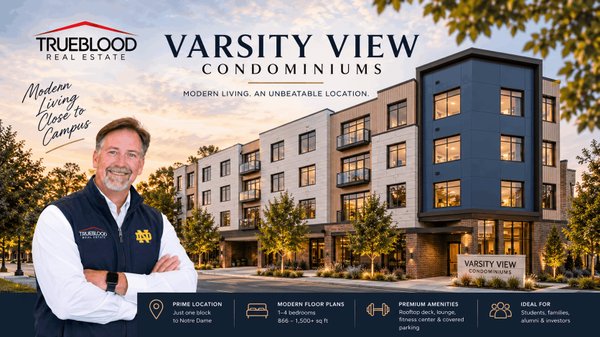
As of mid-2026, condo prices in the 46617 zip code range from approximately $200,000 for entry-level units at complexes like Oak Hill up to $900,000+ for luxury units at new developments like Varsity View or large units at Irish Quarter. The median for campus-adjacent condos and homes runs well above $600,000. Browse current listings by price tier →
Will Notre Dame area property values keep going up?
None of the five structural drivers — national buyer demand, game-day rental economics, supply constraints, buy-vs-rent math, or institutional expansion — are weakening. In 27 years of watching this market, I have not seen a sustained period where campus-adjacent values declined meaningfully. That doesn't mean individual properties can't be overpriced, or that market timing doesn't matter. But the macro case for this micro-market remains stronger today than it was a decade ago.
Related Reading
- South Bend Real Estate Market 2026: What Notre Dame Buyers Need to Know
- Notre Dame Student Housing: Investment Tips for Campus Properties
- Buying Near Notre Dame in 2026: Condo vs. House Cost Breakdown
- Game-Day Rental Properties Near Notre Dame
I'm just curious — what's your situation with the Notre Dame market right now?
Are you actively looking, still in the research phase, or trying to figure out whether buying actually makes more sense than continuing to rent or pay for hotels? I talk through this with buyers all the time, and an honest conversation — with no pressure and no commitment — tends to clear things up faster than any amount of online research.
Tim Vicsik, REALTOR® | RE/MAX 100 / Trueblood Real Estate
📞 574-329-9587
✉️ Tim@TimVicsik.com
Categories
- All Blogs (97)
- Best Time To Sell (9)
- Condos and Villas (22)
- Elkhart (32)
- For Buyers (55)
- For Sellers (29)
- FSBO (13)
- Granger (30)
- Guides (65)
- Housing Market (35)
- Housing Trends (1)
- Inspections (6)
- Lifestyle (10)
- Market Trends (10)
- Mishawaka (30)
- Mortgage (12)
- Notre Dame (68)
- Property Tax (5)
- South Bend (70)
- Things To Do (4)
- Waterfront (1)
Recent Posts









GET MORE INFORMATION