
Beyond the Stadium: The Equity Play in South Bend's Historic Pockets
Updated June 2026 — Indiana's housing market just recorded its best April since 2022. More buyers, more activity, and tightening inventory in the neighborhoods that matter most near Notre Dame. The timing here is real.
What Does "The Equity Play" Mean for South Bend Buyers in 2026?
The equity play in South Bend's historic neighborhoods means buying a single-family home in an area where demand is structurally driven — by Notre Dame proximity, limited housing supply, and a nationally mobile alumni buyer pool — rather than just tracking the broader citywide average. In 2026, that gap between citywide appreciation and alumni-preferred neighborhood appreciation is wide enough to matter significantly to your long-term wealth picture.
Short answer: buying in neighborhoods like Harter Heights, Sunnymede, or North Shore Triangle right now positions you in a sub-market that behaves very differently from the $188,000 South Bend median — typically appreciating faster, holding value more stubbornly during slow cycles, and attracting a more motivated buyer when it's time for you to sell.
Why 2026 Is the Year to Move from a Condo to a Historic Home Near Notre Dame
I've been selling real estate in South Bend for over 27 years. I've seen the market hum, stall, surprise everyone, and reward the patient. In all that time, the one constant has been this: the neighborhoods closest to Notre Dame, with the most irreplaceable housing stock, don't just weather market cycles — they tend to come out the other side stronger than they went in.
What I'm watching right now is a specific window. Indiana's spring 2026 market is the most active it's been since 2022. Buyer demand is up, inventory is still tight in the premium pockets, and outside interest in South Bend — fueled in part by national rankings recognizing this market — continues to pull well-qualified buyers from Chicago, Indianapolis, and the coasts into the Notre Dame corridor. Those buyers aren't shopping the $188,000 citywide median. They're looking for Harter Heights addresses, Sunnymede character, and North Shore Triangle charm. And when they find the right property, they move fast.
That dynamic creates a specific opportunity for the condo owner who has been building equity and is starting to think about the next step. The move from a campus-adjacent condo to a historic single-family home in one of these three neighborhoods isn't just a lifestyle upgrade. Done at the right price on the right property, it's the most deliberate wealth-building play available in this market right now.
The condo-to-house move isn't right for every buyer. But for someone who has already established equity in a campus-adjacent condo, has a longer time horizon, and wants to understand what wealth-building actually looks like in this specific market — this post is written for you.
If you're still deciding whether a condo or house makes more financial sense as a starting point, I'd read my detailed breakdown first: Buying Near Notre Dame in 2026: Condo vs. House Cost Breakdown. This post assumes you've already run that math and are asking the next question: which specific neighborhoods, and why now?
The Three Historic Pockets Quietly Outperforming the South Bend Median
Harter Heights: Where Prestige Has a Street Address
Picture a block where the trees are old enough to arch over the road and meet in the middle, where your neighbor's 1935 American Foursquare has the original leaded glass windows still intact, and where the sound of Notre Dame Stadium on a September Saturday drifts through the neighborhood like background music. That's Harter Heights. It's the kind of place you walk through once and immediately start doing the math on what it would take to live there.
Homes here were mostly built between 1900 and 1950 — stone Tudors that look like they belong in an English village, Craftsman bungalows with front porches built for actual sitting, midcentury ranches with the clean lines that architects charge a premium to mimic today. They exist within genuine walking distance of Notre Dame Stadium, which is not a marketing phrase here — it is a literal description of the geography.
The buyer profile in Harter Heights reflects the neighborhood. Median household income runs around $124,000. These aren't first-time buyers making an impulsive decision — they're professionals, faculty, and Notre Dame alumni who have researched this market, know exactly what they want, and are prepared to pay for it. That's the motivated, qualified buyer you want standing across the closing table when it's your turn to sell.
Short-term price data can be noisy — Harter Heights saw some softness in line with broader market trends over the past year or two, which is normal for any neighborhood trading at a significant premium. The investment thesis here is not about short-term comps. It's about what a property with genuine scarcity value, in a market with structural demand drivers, looks like over a five-to-ten year horizon. That picture is consistently strong.
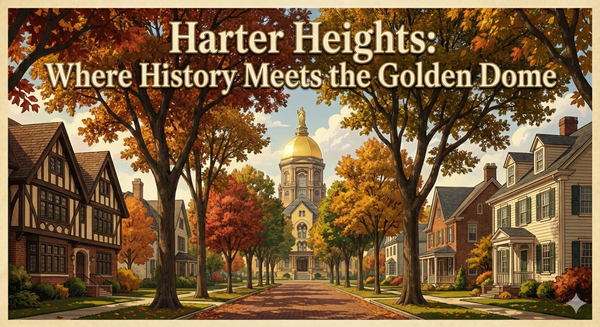
I've written a deep guide specifically on Harter Heights — the architecture, the price tiers, the honest investment case, and what actually separates the best blocks from the rest: Harter Heights: Where History Meets the Golden Dome.
Sunnymede: The Neighborhood Serious Buyers Find When Harter Heights Gets Competitive
There's a moment I see fairly regularly with buyers who come in specifically targeting Harter Heights. They fall in love with the neighborhood, they understand the value case, and then they hit the reality of what the best properties command — and they pause. Some push through and make it work. Others start asking the question that leads them somewhere equally interesting: what's the next neighborhood over, and why doesn't everyone know about it yet?
The answer, more often than not, is Sunnymede.
Sunnymede sits inside the 46617 zip code. It carries the same mature streetscape — established trees, pre-war and midcentury housing stock, the kind of neighborhood bones that take generations to develop and can't be rushed. It benefits from the same Notre Dame proximity. What it doesn't carry, at least not yet, is the full Harter Heights name recognition in the broader buyer market. That gap is the opportunity.
What I've watched happen in Sunnymede over the past several years is a steady re-rating. The buyers who get serious about this market — who spend time actually walking these streets rather than filtering on Zillow — discover Sunnymede and recognize immediately that the value proposition is real. You get most of the neighborhood character, you're still inside the 46617 zip code, and your acquisition cost is meaningfully lower than comparable Harter Heights properties. That inflow of informed, motivated buyers has been putting consistent upward pressure on prices at a pace that the $188,000 citywide median completely masks.
For buyers with a five-to-ten year horizon, Sunnymede currently represents what I'd call the most compelling combination available in this market: below-Harter-Heights entry price with an above-citywide-median appreciation trajectory, inside a zip code that carries genuine Notre Dame cachet with buyers from outside the area.
North Shore Triangle: Architectural Character You Cannot Buy Anywhere Else at This Price
North Shore Triangle is the neighborhood that consistently surprises buyers who haven't spent time in it. Walk the streets for the first time and you notice: Craftsman bungalows sitting next to brick colonials sitting next to the occasional Prairie-style home, all on blocks with that unforced, organic quality that comes from a century of people building houses they actually intended to live in for decades. There's a lived-in warmth to the neighborhood that no developer can manufacture on deadline.
It's genuinely walkable to Notre Dame. Not "fifteen minutes if you drive and find parking" walkable — actually walkable, the way that word was meant to be used before it became a marketing term. That proximity matters in this market the same way it matters in Harter Heights and Sunnymede, which is to say: it creates a floor under demand that doesn't exist in neighborhoods where the university is just a name on a map rather than something you can walk to in your morning routine.
What I find interesting about North Shore Triangle specifically in 2026 is the buyer it attracts. They've almost always done their homework. They're not shopping by algorithm — they're buying based on something they experienced on a Saturday morning walk, a Sunday drive, a visit for a football game. Those are the buyers who create stickiest demand. They're not going to talk themselves out of a purchase because of a slightly elevated asking price or a slow weekend of showings. When they find the right property on the right block, they close.
Pricing still reflects the fact that North Shore Triangle hasn't fully registered with the broader national buyer pool the way Harter Heights has. That is a window. It won't stay open indefinitely.
The "Citywide Median" Trap: Why $188,000 Is the Wrong Benchmark
One of the most common ways I see buyers misread this market is by anchoring to the South Bend citywide median home value. At around $188,000, it sounds like a useful benchmark. For most of the city, it probably is. For anyone buying in Harter Heights, Sunnymede, or North Shore Triangle, it is essentially meaningless.
Here's the honest version of what that $188,000 median actually represents: an average across an extremely wide range of housing stock, including neighborhoods with fundamentally different demand characteristics, different buyer pools, and different long-term trajectories than the Notre Dame corridor. Including all of that in your appreciation benchmark is like pricing a lakefront cottage by averaging it with landlocked properties in the same county. The math works. The comparison doesn't.
Alumni-preferred neighborhoods operate on a demand driver that the rest of South Bend simply doesn't have: a nationally distributed buyer pool of Notre Dame graduates, fans, faculty, and donors who have been watching this specific market their entire adult lives. These buyers don't consult the South Bend citywide median when they decide what a Harter Heights Foursquare or a Sunnymede Craftsman bungalow is worth. They compare it to the last time a comparable property came available, they think about what it would cost to be this close to Notre Dame anywhere else, and they make a decision rooted in that logic. That's what drives premium pricing — and premium appreciation — in these pockets, independent of what the citywide number is doing.
I go into the structural reasons this market behaves differently from the broader South Bend and Midwest average in my investing guide: Investing Near the Golden Dome: Your No-Nonsense Guide to Notre Dame Real Estate. If the investment thesis is what you're trying to stress-test, that post gives you the full framework.
Single-Family vs. Condo: The Appreciation Difference Worth Understanding
The honest answer on why historic single-family homes appreciate faster than condos in these specific neighborhoods comes down to two things: land value and buyer psychology. Both matter, and they reinforce each other.
When you own a condo, your equity is tied to the unit itself and the overall financial health of the building. When you own a single-family home in Harter Heights or Sunnymede, your equity includes the land beneath it — and that land, inside the 46617 zip code with legitimate Notre Dame walking distance, is genuinely scarce. There is no mechanism to produce more of it. New subdivisions don't get built in the middle of established historic neighborhoods. The footprint is fixed. Scarcity compounds appreciation over time in a way that condo supply, which can always be added in the broader market, doesn't replicate.
The buyer psychology piece is subtler but equally real. The pool of buyers willing to pay a premium for a specific historic home on a specific block in Sunnymede is more emotionally motivated than the pool evaluating a comparable condo unit in a building with a waiting list of similar inventory. Emotional motivation doesn't disappear during market softness — it concentrates. The buyers who really want to be on that street in that house tend to show up even when the broader market quiets. That concentration produces stickier values during slow cycles.
None of this is an argument against condos for the right buyer and the right situation. There are distinct buyer profiles for whom a campus-adjacent condo is genuinely the right answer, and I help those buyers find excellent properties every week. But if long-term wealth building is the primary objective and your situation allows for single-family home ownership, the historic pockets in 46617 are where that case is strongest in this market.
What to Look for in a Historic Home Purchase Near Notre Dame
Historic homes in these neighborhoods are not plug-and-play assets. They reward buyers who go in with eyes open and a clear evaluation framework. Here's what I look at most carefully after 27 years of doing this:
Mechanical age, not just cosmetic condition
A 1928 stone Tudor can look impeccable and have a furnace that's one cold snap from retirement, original knob-and-tube wiring in the walls, and galvanized plumbing that has quietly been narrowing for sixty years. Cosmetic condition is easy to read on a walk-through. Mechanical condition requires a thorough inspection from someone who knows historic homes specifically — not a general inspector who has spent most of their career in subdivisions. I have recommendations. Always ask.
The specific line items to press on: age and condition of the HVAC system, electrical panel capacity and type, roof age and material, plumbing materials, and basement drainage. These are also the items that occasionally create financing complications with certain loan types, so knowing the answers before you write an offer matters.
The total cost of ownership calculation
A home listed at $285,000 with $45,000 in deferred maintenance is effectively a $330,000 purchase. I run this math with every buyer before we make an offer, and I do it honestly — which means I'm sometimes the person who talks a buyer out of a property they're emotionally attached to because the numbers don't hold up. That's part of the job. Acquisition price is only the starting point. Total cost to ownership is the number that determines whether the investment thesis works.
The premium within the premium
Even within a neighborhood like Harter Heights or Sunnymede, not every block carries the same demand. Proximity to campus, walkability to Eddy Street Commons, the character of the immediate street, the quality of adjacent properties — all of these create micro-tiers within the neighborhood. The most walkable, most campus-proximate addresses in these neighborhoods have historically held their values most stubbornly during soft patches. If appreciation and eventual resale are part of your calculus, understanding which blocks carry that extra premium before you buy is worth the time.
Historic district designation and what it means practically
Some properties in these neighborhoods fall within historic district designations that govern exterior modifications — window replacement, siding choices, additions. This is not a dealbreaker. Many buyers view it as a feature rather than a constraint, because it protects the character of the neighborhood they're buying into. But you need to know before you buy if your renovation plans include anything that would require review. I'll flag this during our property evaluation if it applies.
The Honest Conversation: Is This Move Right for You Right Now?
I'm going to be direct with you, because that's how I work: not everyone who is thinking about this move should make it in 2026. The right time to buy a historic single-family home in one of these neighborhoods is when your financial position is solid, your time horizon is long enough to let the appreciation thesis play out, and you have realistic clarity about what owning a 90-year-old house actually involves. If any of those conditions aren't in place, the condo you're in may genuinely be the right place to keep building equity right now.
But if you've been in a campus-adjacent condo for a few years, you've built meaningful equity, and you've been quietly asking yourself whether there's a more deliberate wealth-building move available in this market — the answer is yes, and the neighborhoods I've described above are where that move exists right now.
I don't do hard closes. What I do is help buyers understand the full picture, run the numbers with honesty, and make a decision that actually fits their life and their goals. If that sounds like the conversation you'd like to have, reach out. No pressure, no pitch — just 27 years of knowing this market better than almost anyone.
|
Tim Vicsik | Trueblood Real Estate
📞 574-329-9587 | ✉️ Tim@TimVicsik.com
www.ND-Condos.com
Related Reading on ND-Condos.com
- Harter Heights: Where History Meets the Golden Dome — the deep dive on South Bend's most prestigious address, price tiers, and the honest investment case
- Buying Near Notre Dame in 2026: Condo vs. House Cost Breakdown — run the full financial comparison before you make the move
- Investing Near the Golden Dome: Your No-Nonsense Guide to Notre Dame Real Estate — why this market behaves differently from the rest of the Midwest
- The Best Neighborhoods Within Walking Distance of Notre Dame — compare every major campus-adjacent neighborhood before you decide
- Top 5 Family-Friendly Neighborhoods Near Notre Dame — if schools, parks, and family fit are part of your decision
Frequently Asked Questions: Historic Homes and Equity Near Notre Dame
Why are homes in Harter Heights and Sunnymede more expensive than the South Bend median?
Because they operate on a fundamentally different demand driver. Buyers in these neighborhoods are drawn by Notre Dame proximity, historic architecture that can never be replicated, and a nationally distributed alumni buyer pool that is highly motivated when the right property appears. That specialized, emotionally invested demand pool produces and sustains premiums that averaging across the broader South Bend market completely obscures.
Is 2026 actually a good time to buy a historic home near Notre Dame, or should I wait?
My honest take after 27 years: the buyers who have done best in this market are the ones who bought when the fundamentals were sound, not when they felt completely certain about the timing. The fundamentals in 2026 include the tightest inventory in years in the premium neighborhoods, Indiana's most active spring market since 2022, rising outside buyer interest in South Bend, and continued Notre Dame-driven demand. That combination doesn't favor waiting. Waiting for absolute certainty in a market with permanent structural scarcity tends to cost more than acting on sound fundamentals.
What is the difference between buying in Harter Heights versus Sunnymede for appreciation potential?
Harter Heights is the established premium benchmark — higher entry price, the most nationally recognized address in the Notre Dame corridor, historically sticky values. Sunnymede currently offers a lower entry point with a similar appreciation trajectory as outside buyer awareness of the neighborhood continues to increase. Both are inside 46617. Both benefit from the same structural demand drivers. The right choice depends on your budget, your timeline, and which neighborhood feels like home when you walk the blocks.
Do historic homes near Notre Dame hold value better than condos during market downturns?
In my experience with this specific market — and I've watched it through several cycles now — yes, with a caveat. Historic single-family homes in alumni-preferred neighborhoods hold value better during slowdowns because the motivated buyer pool for specific addresses shrinks but doesn't disappear. When demand softens broadly, it tends to concentrate in the most irreplaceable properties. Condos in the same area can see more price softness depending on supply levels in a given building. That said, the most reliable hedge against any market softness is buying sound fundamentals at a fair price, in any property type.
What should first-time buyers know about purchasing a historic home near Notre Dame?
Three things I always make sure buyers understand going in: get a thorough inspection from someone with historic home experience and take every finding seriously; recognize that the character you love often comes bundled with mechanical systems that need attention on a real timeline; and know whether the property falls within any historic district designations that would govern exterior modifications. None of those are dealbreakers — they are part of the informed ownership picture. The upside is a property with genuine scarcity value in a market that has historically rewarded exactly that kind of scarcity over time.
How close are Sunnymede and North Shore Triangle to Notre Dame campus?
Both neighborhoods sit inside the 46617 zip code and are within the orbit of campus that draws Notre Dame buyers and creates the premium demand dynamics I've described in this post. North Shore Triangle in particular carries genuine walkability to campus — not a figure of speech, but an actual walkable distance. Sunnymede is a short drive or comfortable bike ride. Both are meaningfully closer to campus than what the South Bend citywide median price point reflects.
Categories
- All Blogs (96)
- Best Time To Sell (9)
- Condos and Villas (22)
- Elkhart (33)
- For Buyers (57)
- For Sellers (29)
- FSBO (13)
- Granger (31)
- Guides (66)
- Housing Market (36)
- Housing Trends (1)
- Inspections (6)
- Lifestyle (9)
- Market Trends (10)
- Mishawaka (31)
- Mortgage (13)
- Notre Dame (67)
- Property Tax (5)
- South Bend (69)
- Things To Do (3)
- Waterfront (1)
Recent Posts







GET MORE INFORMATION