
How to Compare Offers Without Guessing
That $450,000 Offer Might Be a Trap — Here's How to Tell
But here's the thing — that flashy number at the top of the page might be the worst deal in the pile. I've seen sellers chase the high bid right into a collapsed deal, a missed move-out date, and a lot of very awkward conversations.
I'm going to show you how to actually read an offer — all of it — so you can choose the one most likely to put money in your pocket and get you to the closing table without drama. Whether you're selling a condo near campus or a home in Granger, the math works the same way.
Why the Highest Offer Isn't Always the Best Offer
Let's be blunt: a $450,000 offer with shaky financing and a 60-day close can easily cost you more than a clean $440,000 offer with verified funds and a two-week timeline. The difference shows up in carrying costs (mortgage, taxes, insurance, utilities), the risk of the buyer renegotiating mid-process, and — worst case — the cost of starting over entirely if the deal falls apart.
According to the National Association of Realtors, roughly 5% of home sale contracts are terminated before closing. That number is higher when buyers are stretching financially or when an offer is loaded with contingencies. You want to be in the 95%, not the 5%.
The goal isn't to pick the most impressive offer. It's to pick the most reliable one.
Start Here: How the Buyer Plans to Pay
How a buyer finances the purchase tells you a lot about how smoothly things will go. Here's a quick breakdown of what each financing type actually means for you as the seller:
Cash offers are the gold standard. No lender, no appraisal required by the bank, no underwriting delays. What you see is what you get, and it usually closes fast. If two offers are close in price, the cash buyer often wins on certainty alone.
Conventional financing with 20% or more down is the next best thing. Buyers putting down serious money have real skin in the game. They've typically been fully vetted by a lender, have strong credit, and are less likely to hit a wall during underwriting.
Low-down-payment loans (FHA, VA, or 3–5% down conventional) aren't necessarily bad, but they introduce more variables. These buyers may have less cushion if something unexpected comes up, and FHA loans sometimes trigger additional property condition requirements that could complicate your sale.
One more thing on financing: not all pre-approval letters are created equal. A letter from a reputable local lender who has actually verified income, assets, and credit is worth far more than a five-minute online pre-qualification. Ask your agent to call the lender directly — a five-minute conversation can tell you everything.
Contingencies: Every One Is an Exit Door
A contingency is a built-in escape hatch for the buyer. Some are totally reasonable. Others are loaded with risk. Here are the main ones to watch:
Home Inspection Contingency
Nearly every offer will have one, and that's fine. But the details matter. How many days does the buyer have to complete the inspection? Is there clear language about what qualifies as a "material defect"? A buyer with three days and specific scope gives you more certainty than one with ten days and vague language that lets them walk away because they don't like the age of the water heater.
The inspection period is where many deals quietly start to unravel — sometimes because buyers get cold feet and use inspection findings as cover. Shorter timelines with defined parameters reduce your exposure.
Appraisal Contingency
This protects the buyer if the home appraises below the contract price. But it also gives them an opportunity to renegotiate or walk. In competitive markets, some buyers waive this entirely, while others offer an appraisal gap guarantee — a promise to cover a certain dollar amount over the appraised value out of pocket rather than asking you to drop your price. That kind of commitment separates serious buyers from the tire-kickers.
Home Sale Contingency
This one says: "I'll buy your home after I sell mine." Your deal is now dependent on a completely separate transaction you have no control over. That doubles your risk. Unless it's a slow market and your options are limited, these offers deserve serious scrutiny. If you do accept one, make sure your agent negotiates a kick-out clause so you can continue showing the home and accept a backup offer if a better one comes in.
Earnest Money: What They're Putting on the Line
The earnest money deposit is the buyer's way of saying, "I'm serious, and here's proof." Typical deposits run 1–3% of the purchase price, but deposits of 5% or more are a meaningful signal of intent and financial strength.
A buyer with $20,000 of earnest money on the line is strongly motivated to work through any bumps that come up. A buyer with $1,000 at stake? They might walk if they get nervous, and it won't cost them much to do it.
When you see a strong offer paired with minimal earnest money, that's a yellow flag. It can indicate financial strain, lack of conviction, or simply bad advice from their agent. Any of those situations puts more risk on your side of the table.
The Closing Timeline Has a Dollar Value
Your carrying costs — mortgage payment, property taxes, insurance, and utilities — don't stop just because your home is under contract. They keep ticking until the deal closes. So the timeline matters in real dollars.
Here's a simple way to think about it: estimate your total monthly carrying costs and divide by 30 to get a per-day number. A $3,000/month carrying cost works out to $100/day. A buyer who needs 60 days to close instead of 30 effectively reduces your net proceeds by about $3,000 — even if their offer price is the same.
Longer timelines also create more opportunity for things to go wrong. Buyers have more time to reconsider. Lenders have more time to uncover issues. Life happens. Speed and certainty have real value, even when the dollar amount looks lower on paper.
Do the Math on Net Proceeds — Not Gross Price
Some buyers ask you to cover their closing costs, make repairs, include appliances that weren't listed, or provide credits for planned renovations. Each of those requests chips away at what you actually take home.
The only number that matters is your net proceeds: the purchase price minus concessions, minus your closing costs, minus any repairs you've agreed to complete. A $450,000 offer asking for $8,000 in closing costs and a $5,000 repair credit nets you $437,000. A $440,000 offer with no concessions nets you $440,000. The "lower" offer is actually better.
Run this math for every offer before you make a decision. Your agent can help you build out a quick side-by-side comparison so you're not doing it in your head under pressure.
How to Compare Multiple Offers Side by Side
Here's the framework I use with my sellers when we're looking at multiple offers at once. It turns an overwhelming stack of paper into a clear picture:
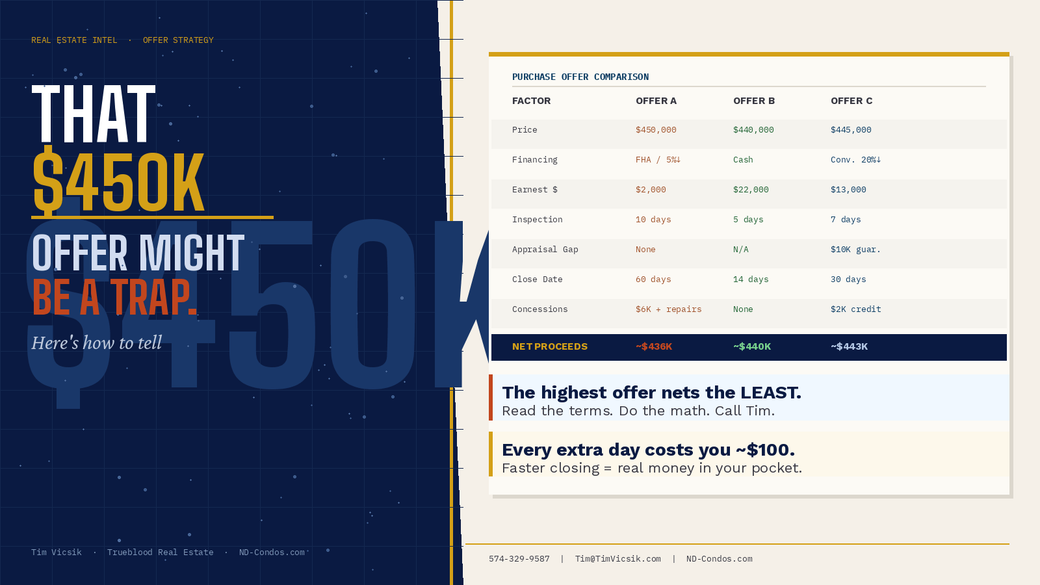
| Factor | Offer A | Offer B | Offer C |
|---|---|---|---|
| Purchase Price | $450,000 | $440,000 | $445,000 |
| Financing Type | FHA, 5% down | Cash | Conventional, 20% down |
| Earnest Money | $2,000 (0.4%) | $22,000 (5%) | $13,000 (3%) |
| Inspection Period | 10 days | 5 days | 7 days |
| Appraisal Gap | None | N/A (cash) | $10,000 guarantee |
| Closing Date | 60 days | 14 days | 30 days |
| Concessions Requested | $6,000 closing costs + repairs | None | $2,000 closing credit |
| Estimated Net Proceeds | ~$436,000 | ~$440,000 | ~$443,000 |
Offer A looked the best until we did the math. Offer B nets more despite a lower price, and closes in two weeks. Offer C is a solid middle ground with strong conventional financing and a modest gap guarantee. Laid out like this, the "best" offer becomes obvious — and it's rarely the one with the biggest number at the top.
Real Scenarios Worth Walking Through
The Cash Offer Below Asking Price: It might sting to accept $430,000 cash versus a $445,000 financed offer. But run the numbers. If the financed offer takes 45 days longer, costs you $3,500 in carrying costs, and carries appraisal risk, you might be netting less even with the "higher" price — and taking on significantly more stress to get there.
Two Financed Offers, Different Timelines: Calculate your per-day carrying cost and multiply by the difference in days. If that math erases the price gap, the faster close wins.
High Price, Heavy Contingencies: This is the classic trap. A buyer who needs you to do repairs, wait on their home sale, and accept a long inspection window is asking you to carry a lot of risk for that extra $10,000. You might be better off with a slightly lower offer that actually closes.
An Experienced Agent Makes This a Lot Less Stressful
Understanding the framework is valuable, but having someone in your corner who does this every day makes a huge difference. A good agent recognizes red flags in pre-approval letters that most sellers would never catch. They know when a buyer is financially stretched. They spot contingency language that sounds standard but is quietly one-sided.
When you're selling near the University of Notre Dame — whether it's a condo on Angela Boulevard or a family home in the surrounding neighborhoods — the market moves fast and the details matter. I've helped sellers here navigate everything from bidding wars to tricky home sale contingencies, and the difference between a good decision and a costly one often comes down to knowing what you're looking at.
The best offer isn't always the highest number. It's the one most likely to close on time, with the fewest surprises, for the most money in your pocket at the end. That's the one we're always looking for.
Thinking about selling your South Bend or Notre Dame area home?
Let's talk through your options — no pressure, just real numbers.
📞 574-329-9587 | ✉️ Tim@TimVicsik.com
Tim Vicsik | Trueblood Real Estate | South Bend, IN
Categories
- All Blogs (97)
- Best Time To Sell (9)
- Condos and Villas (22)
- Elkhart (32)
- For Buyers (55)
- For Sellers (29)
- FSBO (13)
- Granger (30)
- Guides (65)
- Housing Market (35)
- Housing Trends (1)
- Inspections (6)
- Lifestyle (10)
- Market Trends (10)
- Mishawaka (30)
- Mortgage (12)
- Notre Dame (68)
- Property Tax (5)
- South Bend (70)
- Things To Do (4)
- Waterfront (1)
Recent Posts










GET MORE INFORMATION