
Trueblood Real Estate | Notre Dame Condo Guide
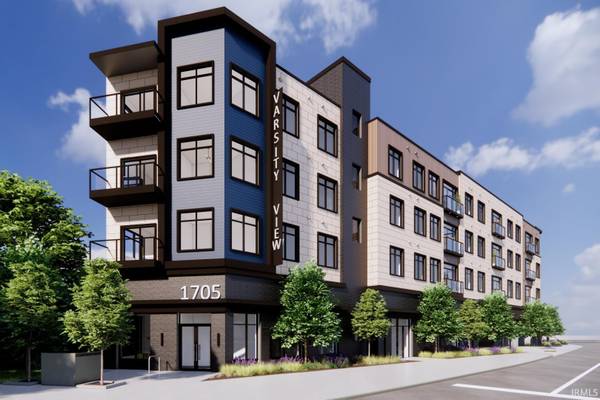
Varsity View Condominiums
Formerly Sideline Flats
Thirty-nine brand-new condos across from the Linebacker, a rooftop that looks straight at the Dome, and a purchase agreement worth reading twice.
| Location1705 South Bend Ave., South Bend, IN, at Angela Blvd. | To the StadiumAbout 0.8 miles; 15–20 min walk to Gate B | Size & Age39 residences on floors 2–4, one ground-floor commercial unit; new construction, originally planned as Sideline Flats |
| AmenitiesRooftop lounge and terraces, resident gym, storage lockers, elevator, dog run | ParkingOne assigned space per unit; covered and covered-secure spaces at a premium | Short-Term RentalsNo. Six-month minimum lease |
Read This First
The Brochure Sells the Rooftop. The Contract Is What You're Buying.
Everybody who tours Varsity View walks up to the fifth floor, sees the Golden Dome and Touchdown Jesus framed over the stadium, and starts doing math in their head. Fair enough. It's a great view. But the view isn't what you sign.
I read the developer's purchase agreement and the recorded condominium declaration line by line. Three terms in them matter more to most buyers than which finish package they pick, and none of them are on the marketing flyer:
• Your deposit isn't held in escrow. The agreement calls for 20% at signing if you're financing, or 25% if you're paying cash (then another 35% at drywall). It says plainly that those deposits can be spent on building the project and won't earn interest.
• You can't resell right away. The purchase agreement bars a resale for 18 months after closing without the developer's written consent. The declaration goes further: until the developer hands over the association, no owner may resell until every residential unit has sold once, unless the developer approves the sale.
• The developer runs the HOA for a long time. Owners don't vote on the budget, the dues or the board until five years after the last unit is sold. Until then, the developer votes for you.
Why this matters before you tour: none of these terms is a reason to walk away if you plan to own and use the place for years. They're a big reason to walk away if you were counting on a quick resale, or on your deposit sitting safely in a title company's account. Know which buyer you are before you pick a floor.
Twelve Floor Plans, Decoded
Each residential floor has 13 units, numbered 201–213, 301–313 and 401–413, along an L-shaped corridor with an elevator in the middle. The same plan stacks on every floor, so unit 207, 307 and 407 share a layout. Here's how the plans sort out:
| Bedrooms | Plans | Approx. Size | Best Read As |
|---|---|---|---|
| 1 bedroom | 2 | 866–897 sq ft | The entry point; game-day base or faculty pied-à-terre |
| 2 bedroom | 2 | 1,151–1,159 sq ft | A guest room, or a senior-year student plus one |
| 3 bedroom | 7 | 1,243–1,576 sq ft | Most of the building; the corner plans run largest |
| 4 bedroom | 1 | 1,584 sq ft | Rare near campus; the lowest price per square foot in the building |
The developer's published prices have run from about $516,000 to about $1.03 million, with each floor up carrying a premium. Ask me for the developer’s current price sheet; the live listings below are the current numbers. Weighing it against the building down the street? Here’s Varsity View vs. Irish Quarter, side by side.
What You're Actually Buying
You get fee simple title to your unit, its own tax parcel, and an equal undivided share of everything else: the land, the structure, the garage, the gym and the roof. The first floor holds parking, a resident lobby, the gym, storage lockers and one commercial unit. The fifth floor is the shared rooftop lounge and terraces. A few things are worth knowing about that package:
• The association maintains more than usual. Under the declaration, the HOA handles the structure, roof, windows, doors, ceilings, and even the water, plumbing, electric and gas lines inside the units. You handle your appliances, fixtures and interior finishes.
• Finishes are pre-selected. Buyers choose between two design packages; this isn't a custom build. The developer can also substitute materials of "comparable or greater quality" without asking you.
• Every unit pays the same HOA dues. The declaration gives each unit an equal share regardless of size. The 866-square-foot one-bedroom pays exactly what the 1,584-square-foot four-bedroom pays. That makes the big plans a better deal on dues and the small ones a little heavier.
• Your neighbor downstairs is a business. One first-floor unit is commercial. Until the developer turns over the association, the developer decides what kind of business goes there; after that, the owner can lease it for any lawful commercial use. Commercial tenants and customers can't use the roof.
Who Varsity View Fits (and Who It Doesn't)
The Notre Dame parent with a long runway
Notre Dame expects undergrads to live on campus for six semesters, so the realistic plan is a family base for game weekends and visits, then your student's home senior year, then keep it or sell it. The resale restrictions matter less when your plan already runs four years or more. Here's how families are running that math.
The alum who wants a seat at the window, not a rental business
A 15-to-20-minute walk to Gate B, an elevator instead of stairs, and a rooftop lounge facing the stadium. If you'll use it yourself, it's hard to beat. If you need it to earn money on football weekends, it won't.
Faculty, staff, grad students and empty nesters
Single-level living, nothing to mow or shovel, a walk to campus and Eddy Street, and a building without weekend-rental turnover. The one-bedroom is the lowest-priced way into brand-new construction this close to Notre Dame.
Probably not a fit if…
You're planning short-term rentals, you might need to sell inside two years, your household has two cars and you don't want to pay for a second space, you can't live without a grill, or you'd lose sleep knowing your deposit is funding construction. The documents rule out or complicate all five, and I'd rather say so now than after you've picked a floor.
Live from the MLS
What's Available at Varsity View Right Now
These are developer units, listed by the developer's brokerage. Most of the building has already gone pending, so what's left is usually a handful of specific units on specific floors. You can bring your own agent to any of them.
VARSITY VIEW CONDOMINIUM LISTINGS
- 1/14 14
 1 Bed 2 Baths 866 SqFt$562,260Pending
1705 South Bend Ave Unit 410 AVE #410, South Bend, IN 46617
Listed by Stephen Smith of Irish Realty
Condo

- 1/13 13
 1 Bed 2 Baths 897 SqFt$580,418Pending
1705 South Bend Ave Unit 411 AVE #411, South Bend, IN 46617
Listed by Matthew Kruyer of Irish Realty
Condo
- 1/5 5
 3 Beds 2 Baths 1,576 SqFt$979,474Pending
1705 South Bend Unit 306 AVE #306, South Bend, IN 46617-1504
Listed by Stephen Smith of Irish Realty
Condo
- 1/13 13
 3 Beds 2 Baths 1,420 SqFt$823,810Pending
1705 South Bend Ave Unit 204 AVE #204, South Bend, IN 46617-1504
Listed by Stephen Smith of Irish Realty
Condo
- 1/7 7
 1 Bed 2 Baths 866 SqFt$516,063Active
1705 South Bend Ave Unit 210 AVE #210, South Bend, IN 46617
Listed by Stephen Smith of Irish Realty
Condo
- 1/11 11
 2 Beds 2 Baths 1,154 SqFt$668,050Active
1705 South Bend Ave Unit 207 AVE #207, South Bend, IN 46617
Listed by Stephen Smith of Irish Realty
Condo
- 1/13 13
 3 Beds 2 Baths 1,420 SqFt$888,955Pending
1705 South Bend Ave Unit 304 AVE #304, South Bend, IN 46617-1504
Listed by Stephen Smith of Irish Realty
Condo
- 1/5 5
 3 Beds 2 Baths 1,576 SqFt$1,031,482Pending
1705 South Bend Unit 406 AVE #406, South Bend, IN 46617-1504
Listed by Stephen Smith of Irish Realty
Condo
- 1/13 13
 3 Beds 2 Baths 1,420 SqFt$1,024,123Pending
1705 South Bend Ave Unit 413 AVE #413, South Bend, IN 46617-1504
Listed by Stephen Smith of Irish Realty
Condo
Before You Fall for a Listing, Ask Three Questions
Which way does it face? South Bend Avenue is one of the main roads into campus, Angela Boulevard is busy too, and the Linebacker across the street is lively late on weekends. You can change finishes. You can't change which way the bedroom windows point. Ask for the floor plate.
Which floor, and is the premium worth it? The same plan costs more on three than on two, and more again on four. Everyone shares the rooftop, so a higher floor buys distance from the street, not the Dome view.
Which parking space? Every unit gets one assigned space. Covered and covered-secure spaces cost extra and go first come, first served. Find out exactly which space is in the deal, and whether it's in the price you're looking at.
Closed Sales
What's Actually Sold at Varsity View
In a brand-new building, closed sales are first sales from the developer. They read differently from resales in an older complex:
Compare the same plan on different floors. Unit 210 and unit 410 are the same layout. The gap between them is the floor premium, and it tells you what the market is paying for height.
Know what was in the price. A premium parking space, the upgraded design package or a pre-construction discount can each move a closing price. Ask before you treat one sale as the going rate.
Remember these become the comps. The first round of sales is what appraisers will lean on when the first resales come, and with the resale restrictions, those may be a while. If you're financing, that matters to your appraisal now, too.
No Listings?
If you don't see anything here, there are no recent sales at this location.
The HOA: What $395 a Month Actually Covers
The current purchase agreement quotes the regular assessment at $395 per unit per month, the same for every residence. On closing day you'll also write three checks to the association:
| Due at Closing | Amount | What It's For |
|---|---|---|
| Prorated dues | Rest of the closing month | Your share starting the day you close |
| Security deposit | 3 months of dues (about $1,185) | Held against future dues |
| Initial Owner Assessment | $1,000 | Startup common expenses, the master insurance premium, and reimbursing the developer's cost of creating the association |
|
The association covers Master casualty insurance on the building • liability insurance • roof, structure, exterior and interior walls • windows, doors and ceilings • water, plumbing, electric and gas lines, including those inside your unit • hallways, lobby, elevator • gym, rooftop lounge, storage lockers • parking garage and lot • trash chutes • landscaping and snow • a reserve fund for future replacements |
You pay separately Gas, electric, water and sewer (each unit is metered) • internet and TV, unless the association contracts for it • your own unit insurance (see below) • appliances and fixtures • paint, flooring and interior finishes • property taxes |
The questions that matter more than the fee
A new building has no history, so the first budget is a forecast. Until owners take over, the developer's board sets that budget alone. The declaration lets the developer raise dues up to 15% a year starting in 2026. It also exempts the developer from paying dues on unsold units: it covers any shortfall in the budget, and it may keep any surplus. When the declaration was recorded in June 2025, it listed dues at $300 a month. Today's agreement says $395. Neither of those is a red flag by itself, but each is a reason to ask for:
• The current first-year budget, line by line
• How much of each month's dues goes to the reserve fund, and what the reserve study (if any) assumes
• The master insurance premium, since it's the line most likely to climb
• Who the managing agent is, and whether it's tied to the developer
I keep a full checklist for this: what to verify on a new condo before any HOA history exists.
How Buying Here Actually Works
A refundable reservation deposit holds a unit while you decide. The purchase agreement is where the commitment starts. Here's what it says, in plain English:
| The Agreement Says | What It Means for You |
|---|---|
| 20% down at signing if financing; 25% if paying cash, plus 35% at drywall | That money isn't escrowed. It can be spent on construction, earns no interest, and your rights rank behind the construction lender's mortgage until you close. |
| Apply for a loan within 7 days, with a lender the seller approves | You get 30 days to secure a commitment. If you don't give written notice that the loan fell through in time, you've waived the financing contingency. |
| Estimated completion around November 15, 2026 | Delays beyond the seller's control can push closing up to 90 days. If the unit isn't done by September 1, 2027, you can terminate and get your deposits back. That refund is your only remedy. |
| The seller can cancel if project financing or title falls through | Deposits are returned in that case. Ask what stage the building is at and how construction is financed before your deposit goes in. |
| Close within 15 days of substantial completion | The seller picks the title company. You pay the closing costs, including the owner's title policy, which sellers usually pay in Indiana. Miss the date and it's $150 a day; 20 days late and you're in default. |
| Attend the Owner Orientation walkthrough | Skip it, or skip signing the form, and you waive your warranty. You get one formal 12-month warranty review. Appliances carry only the manufacturer's warranty, and implied warranties are disclaimed. |
| The developer may amend the declaration before closing | You sign a limited power of attorney letting it do so without your signature, and you're still obligated to buy. Ask for the current recorded version and any amendments right before closing. |
| Disputes go to St. Joseph County court | No jury, no class actions, and the losing side pays the winner's attorney fees. |
I'm not an attorney, and this isn't legal advice. On a purchase this size, have a real estate attorney review the agreement before you sign. The developer's sales team represents the developer; you're entitled to your own agent.
When Can You Sell?
Two documents answer this, and the stricter one wins. The purchase agreement says no resale for 18 months after closing without the developer's written consent, which it can withhold for any reason. The recorded declaration says that until the developer turns the association over to the owners, no owner may resell until every residential unit has sold once, again unless the developer consents.
If the building sells out quickly, the second rule may not bite. If a few units linger, it could. Either way, every resale after the first sale also owes a transfer assessment, set by the board and paid into the reserve fund, and the board can hold up the transfer until it's paid.
If there's a real chance you'll need to sell within two or three years, an established building without these restrictions is the safer bet.
The Rules That Surprise Buyers
The covenants in the declaration run from (a) to (aa). Most are standard. These are the ones that catch people:
• No grilling or cooking of any kind outside your unit. That includes the balcony. The balcony tailgate is off the table.
• Your parking space can move. The space assigned in your purchase agreement is a limited common area, not a deeded spot, and the declaration lets the board reassign spaces at its discretion. Vehicles parked outside assigned spaces can be towed.
• You can't rent your space on game day. Renting parking to anyone by the day or hour is prohibited.
• Bikes don't go in the hallway. Bicycles, scooters and mopeds can be stored only in designated areas.
• Windows are the board's business. Blinds and window coverings must be approved, nothing else may be displayed in a window, and you can't change the color or style of windows or exterior doors.
• No flags, flagpoles, antennas or satellite dishes on the exterior. Holiday decorations need board approval, and the board sets how long they stay up.
• Pets are welcome, with a catch. Dogs, cats and other household pets are allowed, with no size or number limits in the declaration. But the board can require a pet deposit, bar a specific pet, and order a nuisance pet removed within 10 days.
• Your insurance has a floor. Your own policy must carry limits of at least what the unit first sold for, name the association as an additional insured, and the developer can require every owner to use the same insurance company or agency.
Can You Rent It Out?
Short-term, no. The declaration bans Airbnb-style rentals by name and sets a six-month minimum lease unless the board approves otherwise in writing. Units the developer still owns are exempt. After the developer turns over the association, a majority of owners can change the leasing rules.
Longer leases are allowed, within South Bend's limit of two unrelated occupants. The developer has also said units can't be leased to undergraduates. That limit isn't written into the recorded declaration, so ask how it's applied. An owner's own student living in the unit isn't a lease.
If game-day income is part of the plan, look at buildings marked for short-term rentals on the comparison chart instead.
Property Taxes and Insurance
Indiana caps property taxes at 1% of assessed value for a homestead and 2% for a second home or rental. On a $750,000 unit, that's roughly $7,500 a year versus $15,000. New construction adds a wrinkle: the first tax bills may reflect land or a partly built building, and the agreement warns that the next bill can be much higher. Your unit's tax parcel can take a while to be created, and you're responsible for post-closing bills even if they arrive in someone else's name. Here's how St. Joseph County property taxes work.
Because of the purchase-price insurance minimum, get an HO-6 quote before you sign, not after. Local agents who write condo policies are here.
Game Day from Varsity View
This is a true walk-to-the-game address: about 0.8 miles to Gate B, 15 to 20 minutes on foot, past the Linebacker and through the crowd. You'll be back upstairs while the parking lots are still trying to empty.
Plan around two things. You get one space, and street parking around this corner disappears on football Saturdays, so visiting family needs a plan. And with no outdoor grilling, the pregame happens inside or up on the rooftop lounge, which is the better view anyway.
More on why parking matters near campus in the game-day parking buyer's guide.
Varsity View: Questions Buyers Ask
Where is Varsity View, and how far is it from Notre Dame Stadium?
Varsity View Condominiums is at 1705 South Bend Avenue in South Bend, Indiana, at the corner of South Bend Avenue and Angela Boulevard, across from the Linebacker Lounge. It's about 0.8 miles from Notre Dame Stadium, roughly a 15- to 20-minute walk to Gate B.
What are the HOA fees at Varsity View?
The current purchase agreement quotes regular assessments of $395 per unit per month, the same for every unit regardless of size. At closing, buyers also pay a $1,000 Initial Owner Assessment and a deposit equal to three months of dues. The developer may raise dues up to 15% a year before owners take control of the association.
Are short-term rentals allowed at Varsity View?
No. The recorded declaration prohibits short-term rentals, including Airbnb, and requires leases of at least six months unless the board approves otherwise in writing. Owners also may not rent their parking spaces by the day or hour.
How much is the deposit to buy at Varsity View?
A refundable reservation deposit holds a unit. Under the purchase agreement, financed buyers then pay 20% of the price at signing, and cash buyers pay 25% at signing plus 35% at drywall. Those deposits are not held in escrow and may be used for construction.
Can I resell a Varsity View condo right away?
Not without the developer's consent. The purchase agreement prohibits resale for 18 months after closing, and the declaration prohibits resale until all residential units have sold once, unless the developer approves the sale.
How much parking comes with a Varsity View condo?
Each unit comes with one assigned parking space. Covered and covered-secure spaces are available for an added price on a first-come basis. There are no private garages, and the board may reassign spaces.
Are pets allowed at Varsity View?
Yes. Dogs, cats and other customary household pets without aggressive tendencies are allowed, with no size or number limits in the declaration. Pets must be leashed and attended outside, and the board may require a pet deposit or bar a specific pet.
Who controls the Varsity View HOA?
The developer, Brennans Walk Holdings LLC, controls the association until five years after the deed for the last unit sold is recorded, unless it hands over control earlier. Until then, owners do not vote on the budget, dues, directors or managing agent.
If Varsity View Isn't Quite Right
Sometimes the best thing a page can do is send you somewhere else. Depending on what ruled it out:
• You want rental flexibility or a private garage: The Parisi, the other new building on South Bend Avenue, is all two-bedrooms at a higher price per square foot, but it's marketed with short-term rentals allowed and offers optional garages.
• You want a different new building nearby: Irish Quarter is the same distance from the stadium and is marked for short-term rentals on my comparison chart. Read its documents just as closely.
• You might need to sell in a couple of years: an established resale building like Oak Hill has years of sales history, an owner-run HOA and no developer consent to sell.
• You want the shortest walk, whatever it takes: Eddy Street Commons is half a mile from the stadium, though listings there are rare.
• You want to see everything at once: the comparison chart lines up 30 communities by distance, rental rules and more.
Does the Contract Fit Your Plan?
I'm just curious what has you looking at Varsity View. Is it the walk to the stadium, a home for your student's senior year, or something else? Tell me how you'll use it and how long you'll keep it, and I'll walk you through the price sheet, the parking and the agreement. If the terms don't fit, I'll tell you that too.
See Current Listings & Sales 574-329-9587
Tim Vicsik | Broker Associate, Trueblood Real Estate | Tim@TimVicsik.com
Based on the Varsity View purchase agreement form and the Declaration of Varsity View, a Condominium (St. Joseph County Instrument Nos. 2025-12797 and 2025-12922), reviewed October 2026. Terms, pricing and availability are set by the developer and may change; verify everything in your own contract and the current recorded documents.